


What's the Best Solar Battery? Your Key to Energy Independence
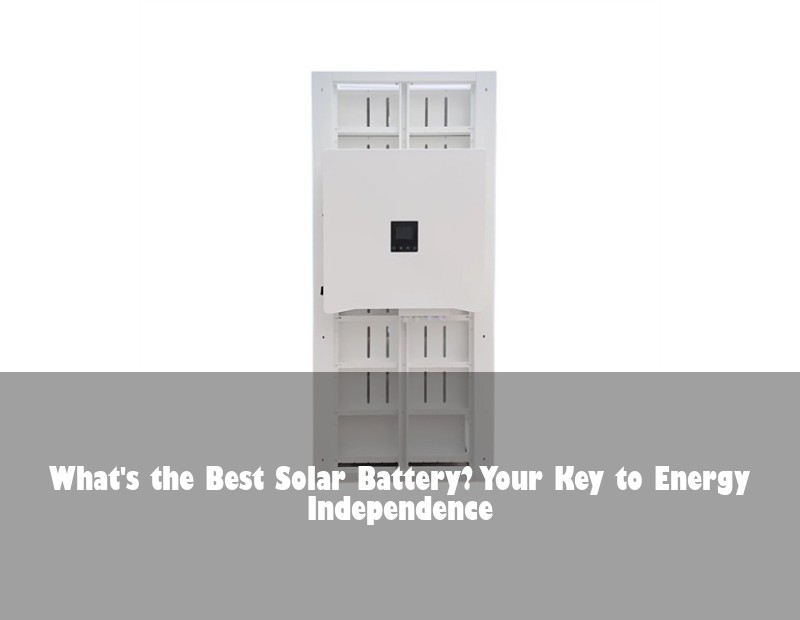
You've invested in solar panels, soaking up the sun's free energy. But what happens when the sun sets, or during a grid outage? That's where finding the best solar battery becomes crucial. It's the heart of a truly resilient and self-sufficient home energy system, especially across Europe where energy prices fluctuate and sustainability goals are paramount. Let's navigate the key factors to find your perfect energy storage match.
Table of Contents
- Understanding Your Energy Needs: More Than Just Size
- Key Factors Defining the "Best" Solar Battery
- Battery Chemistry: The Powerhouse Within
- Real-World Performance: A Case from Germany
- Beyond Technology: Installation & Ecosystem
- Making Your Best Choice
Understanding Your Energy Needs: More Than Just Size
Choosing the best solar battery isn't about picking the biggest one on the shelf. It's about aligning technology with your specific goals. Ask yourself:
- Self-Consumption: Do you primarily want to maximize using your own solar power day and night, reducing reliance on the grid?
- Backup Power: Is ensuring critical appliances (fridge, lights, heating controls) work during blackouts your main driver?
- Energy Arbitrage: Are you looking to store solar when rates are low and use it or even sell back when rates are high (where supported)?
- Future-Proofing: Are you planning to add an EV charger or expand your solar array later?
Your answers directly influence the required battery capacity (kWh), power output (kW), depth of discharge (DoD), and necessary features like backup capabilities.
Key Factors Defining the "Best" Solar Battery
Once your goals are clear, evaluate batteries based on these critical performance and longevity metrics:
Capacity & Power: The Dynamic Duo
Think of capacity (kWh) as the size of your fuel tank and power (kW) as the size of the fuel line. A battery with high capacity but low power might run your fridge for a long time but couldn't start a power-hungry heat pump. Conversely, high power with low capacity provides short bursts of backup. The best systems balance both for your specific appliance loads.
Round-Trip Efficiency: Don't Waste Your Sunshine
This measures how much energy put *into* the battery is usable when taken *out*. A 90% efficiency means for every 10 kWh you store, you get 9 kWh back. Higher efficiency (typically 90-95% for modern lithium-ion) means more of your precious solar energy is utilized, directly impacting your savings and system effectiveness. Lower efficiency batteries waste energy as heat.
Lifespan & Cycles: Investing in Longevity
Solar batteries degrade over time. Look for the warranty specifying both the number of years and the throughput (total energy guaranteed over its life) or cycle life (full charge/discharge cycles). A quality lithium-ion battery today often offers a 10-year warranty with 6000+ cycles or 60-80% residual capacity at end-of-warranty. This ensures your investment pays off over the long term.
Depth of Discharge (DoD): Using Your Battery Fully
DoD indicates how much of the battery's total capacity can be safely used. A 10kWh battery with 90% DoD means you can regularly use 9kWh without significantly harming its lifespan. Higher DoD (like 90-100% for Lithium Iron Phosphate) gives you more usable energy per cycle compared to older chemistries with lower DoD.
Battery Chemistry: The Powerhouse Within
The core technology dictates performance, safety, and cost. Here's the European landscape:
- Lithium Iron Phosphate (LFP): Increasingly the frontrunner for European homes. Offers superior safety (chemically stable), long lifespan (often 6000+ cycles), excellent thermal stability, and high DoD (90-100%). While slightly less energy-dense than NMC, its safety and longevity make it ideal for residential use. Think brands like BYD, sonnen, many Tesla Powerwall iterations.
- Nickel Manganese Cobalt (NMC): Higher energy density (more compact size for same capacity) and slightly higher round-trip efficiency than LFP. Historically more common. However, it generally has a slightly shorter lifespan (3000-5000 cycles), lower DoD (often 80-90%), and requires more complex battery management for safety. Used by LG Chem (RESU), earlier Tesla Powerwalls, Samsung SDI.
- Lead-Acid (Flooded/Gel/AGM): Older technology, significantly cheaper upfront. However, very low DoD (often 50% max), short lifespan (3-7 years, 500-1500 cycles), lower efficiency (70-85%), and require ventilation. Not generally recommended for new daily-cycling solar storage but may persist in some very budget-conscious or specific backup-only scenarios.
For most European homeowners seeking the best balance of safety, longevity, performance, and value over 10+ years, LFP chemistry is often the optimal choice.
Real-World Performance: A Case from Munich, Germany
Let's move beyond theory. Consider the Müller family near Munich:
- Goal: Maximize self-consumption of their 8kWp solar array and have basic backup for outages.
- System: Installed a 10kWh LFP battery (92% round-trip efficiency, 100% DoD, 10yr/10,000 cycle warranty).
- Results (1st Year):
- Increased self-consumption from 35% to over 80%.
- Reduced grid electricity purchases by 68% year-round.
- Experienced two short grid outages (totaling 8 hours). The battery seamlessly powered lights, fridge, internet, and critical heating controls without interruption.
- Based on current energy prices and their feed-in tariff, they project a payback period of approximately 8-9 years, well within the battery's warranty period.
This mirrors trends observed across Germany, where LFP adoption is surging due to its reliability and long-term value. Studies by institutes like Fraunhofer ISE consistently show modern lithium batteries significantly boosting self-consumption rates compared to solar-only systems.
Beyond Technology: Installation & Ecosystem
The "best" battery isn't just about specs; it's about integration:
- AC vs. DC Coupling: AC-coupled batteries (like most retrofit installations) offer flexibility and easier integration with existing solar. DC-coupled can be slightly more efficient but often requires a compatible hybrid inverter from the start. Discuss with your installer.
- Inverter Compatibility: Ensure the battery seamlessly communicates with your existing or new solar inverter. Opting for a battery and inverter from the same brand often ensures smoother integration and access to advanced features.
- Smart Energy Management: The best batteries are part of a smart system. Look for integration with energy management platforms (like SolarEdge Energy Hub, Fronius Solar.web, or manufacturer-specific apps) that allow monitoring, optimization, and potential future integration with smart tariffs or EV charging.
- Installation Quality: A top-tier battery installed poorly won't perform optimally. Choose a certified, experienced installer familiar with the specific product and local regulations (like VDE-AR-E 2510-50 in Germany or equivalent safety standards).
- Warranty & Local Support: A strong warranty (10 years is standard) is essential. Equally important is the manufacturer's presence and support network in your country. Can you get timely service if needed?
Understanding the UK's unique Smart Export Guarantee (SEG) tariffs, for instance, might influence how you program your battery discharge compared to someone in Spain with different net metering rules.
Making Your Best Choice
So, what's the best solar battery? It's the one that optimally balances performance, safety, longevity, and cost for *your* unique home, energy goals, and budget within the European context. For most homeowners prioritizing daily cycling, safety, and a 10+ year investment:
- Prioritize Lithium Iron Phosphate (LFP) for its safety, long cycle life, and high usable capacity.
- Define Your Capacity & Power Needs based on consumption patterns and backup requirements.
- Demand High Round-Trip Efficiency & DoD to maximize your solar energy utilization.
- Choose a Reputable Brand with Local Support and a strong 10-year warranty.
- Partner with a Certified Installer experienced with your chosen system.
Look for certifications like the VDE in Germany or equivalent safety marks in your country. Don't hesitate to ask installers for performance simulations based on your historical energy data.
Considering the Future
Energy storage is evolving rapidly. While LFP is the current frontrunner for residential use, keep an eye on emerging solid-state battery technologies promising even higher energy density and safety. However, for installations today, LFP offers proven, bankable performance.
Ready to Take Control of Your Energy?
Finding the best solar battery empowers you to maximize your solar investment, increase energy independence, and build resilience against rising costs and grid instability. It's a significant step towards a sustainable energy future for your home. What specific energy challenge in your household are you most eager to solve with battery storage?
 Inquiry
 Online Chat