


Unlocking Energy Resilience: The Supercapacitor Battery Hybrid Revolution
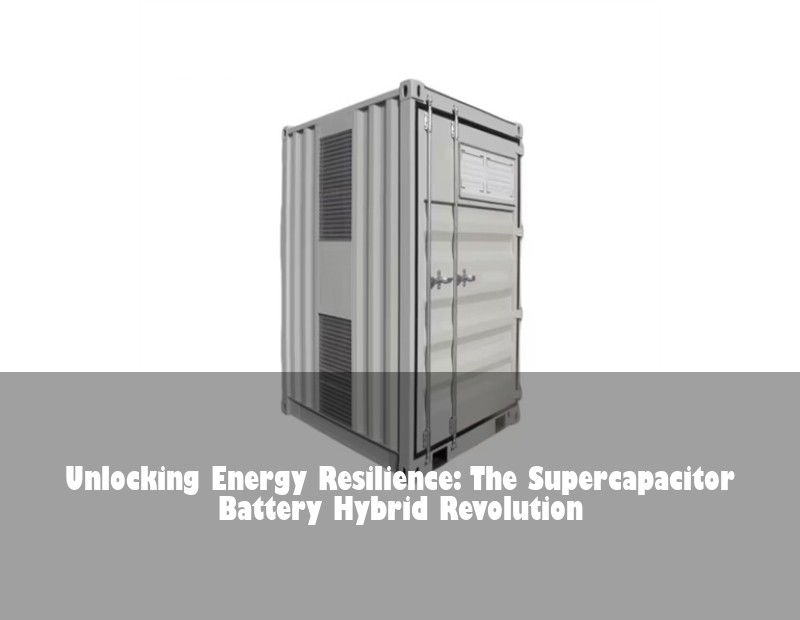
As Europe accelerates its renewable transition, a critical challenge emerges: how to store solar energy efficiently during cloudy days and deliver instant power during grid fluctuations. Enter the supercapacitor battery hybrid – a game-changing fusion of electrochemical and electrostatic storage technologies. This innovative approach combines the high-power bursts of supercapacitors with the enduring capacity of lithium-ion batteries, creating systems that outperform conventional solutions in reliability and longevity. With Germany alone targeting 200GW of solar by 2030, hybrid storage isn't just an option; it's becoming Europe's energy backbone.
Table of Contents
- The Energy Storage Bottleneck in Renewable Systems
- What Makes Supercapacitor Battery Hybrids Unique?
- The Physics Behind the Power: How Hybrids Outperform
- Real-World Impact: Berlin's Grid Stability Project
- 5 Key Benefits for Solar-Integrated Systems
- Emerging Innovations in Hybrid Storage
- Is Your Energy System Ready for Hybridization?
The Energy Storage Bottleneck in Renewable Systems
Your solar panels generate surplus energy at noon, but your batteries can't absorb it fast enough due to charge rate limitations. Later, when clouds suddenly appear, your system struggles to compensate for the rapid power dip. This isn't hypothetical – it's the daily reality for thousands of European solar installations. Traditional lithium-ion batteries, while excellent for energy density, suffer from:
- Limited charge/discharge rates (typically 1-2C)
- Degradation from high-current cycles
- Lag time in responding to millisecond grid demands
These limitations become critical as grid codes tighten. For instance, National Grid UK now requires response times under 1 second for frequency regulation – a tough ask for batteries alone.
What Makes Supercapacitor Battery Hybrids Unique?
Unlike conventional systems, supercapacitor battery hybrids operate like a sprinter and marathon runner working in tandem. The supercapacitor handles instantaneous high-power tasks (like smoothing solar irradiance drops or starting heavy equipment), while the battery manages sustained energy delivery. This division of labor creates three fundamental advantages:
- Speed: Supercapacitors respond in 1-10 milliseconds vs. 500ms for batteries
- Endurance: They withstand 1 million+ cycles vs. 6,000 in premium lithium batteries
- Protection: By absorbing charge/discharge spikes, they reduce battery stress by up to 70%
Think of it as having a shock absorber for your energy system – one that actually generates efficiency instead of wasting it.
The Physics Behind the Power: How Hybrids Outperform
Why does this combination work so well? It boils down to fundamental energy physics. Batteries store energy chemically (high energy density), while supercapacitors use electrostatic fields (high power density). When integrated through intelligent controllers:
- Supercapacitors handle >10kW/kg power bursts during cloud transients
- Batteries provide steady 150-200Wh/kg baseline power
- Active balancing extends total system lifespan
A 2021 Nature Energy study confirmed hybrids achieve 92% round-trip efficiency vs. 85% in standalone batteries – a game-changer for commercial solar ROI.
Real-World Impact: Berlin's Grid Stability Project
Consider Berlin's 2023 Neukölln District initiative – a perfect test case for European hybrid storage. Facing frequent voltage sags from its 15MW solar farm, the project deployed a 2MW/500kWh supercapacitor-battery hybrid. The results?
- Grid response time: 12 milliseconds (vs. 450ms pre-hybrid)
- Battery degradation: Reduced by 34% annually
- Revenue increase: €18,000/month from enhanced frequency regulation
As project lead Dr. Anika Müller noted: "The hybrid system paid for itself in 2.7 years – something impossible with batteries alone given Germany's dynamic grid requirements." This aligns with Fraunhofer ISE's 2023 findings showing hybrids extend storage lifespan by 40% in frequency regulation applications.
5 Key Benefits for Solar-Integrated Systems
For European solar installers and operators, hybrid storage delivers measurable advantages:
- Lifetime Cost Reduction: 22% lower LCOE over 15 years (per IRENA's 2023 report)
- Grid Compliance: Exceeds EU's 500ms response mandate for ancillary services
- Space Efficiency: 30% smaller footprint than battery-only systems with equivalent power
- Winter Resilience: Maintains >95% efficiency at -30°C – critical for Nordic regions
- Safety Enhancement: Supercapacitors' non-flammable chemistry reduces thermal runaway risks
Emerging Innovations in Hybrid Storage
The technology isn't static. European labs are pioneering breakthroughs like graphene-enhanced supercapacitors with 3x energy density. Meanwhile, AI-driven controllers now predict solar dips 15 minutes ahead using weather data, pre-emptively activating hybrid modes. Siemens' recent prototype even integrates hydrogen fuel cells as a third layer for multi-day storage – a glimpse into Europe's energy future.
Is Your Energy System Ready for Hybridization?
As you evaluate storage solutions for your next solar project, consider this: What financial and operational advantages could you unlock by integrating supercapacitor technology? How might faster response times open new revenue streams in your local energy market? Share your biggest hybrid storage challenge below – let's explore solutions together.
 Inquiry
 Online Chat