


Unlocking the Solar Business in Bangladesh: Opportunities for Global Investors
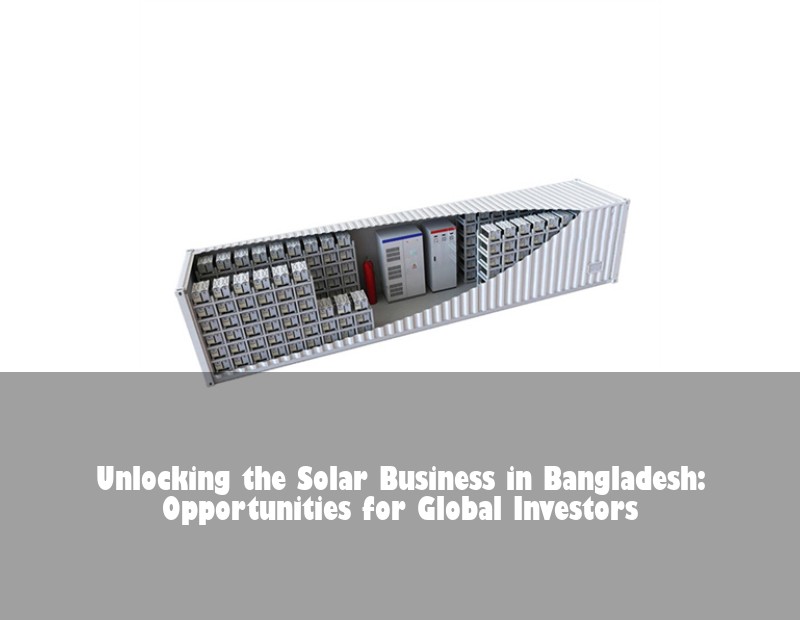
Table of Contents
- Bangladesh's Energy Revolution: Why Solar is Surging
- The Solar Phenomenon: Data-Driven Growth Trajectory
- European Success Story: Scatec's Landmark Rooftop Project
- 3 High-Yield Solar Investment Sectors for European Businesses
- Navigating Market Entry: Practical Strategies for European Players
- Beyond Panels: Next-Gen Opportunities in Storage and Smart Grids
- What Solar Innovation Could Transform Bangladesh's Energy Future?
Bangladesh's Energy Revolution: Why Solar is Surging
Imagine a nation where 67% of rural households lacked electricity in 2009, now targeting 40% renewable energy by 2041. That's Bangladesh's solar transformation. With World Bank data showing 6.8% annual GDP growth fueling energy demand, traditional grids strain under rapid urbanization. Solar isn't just an alternative here—it's becoming the backbone of energy security.
The Solar Phenomenon: Data-Driven Growth Trajectory
Bangladesh's solar capacity exploded from 3MW in 2010 to over 329MW today. The IRENA reports 6 million solar home systems installed, powering 13% of the population. But consider this:
- Industrial Opportunity: Garment factories (84% of exports) face 120+ annual power outages, costing $1bn in losses
- Policy Catalyst: Net metering policies allow 70% electricity bill reduction for commercial users
- Untapped Potential: 50,000+ textile mills could adopt solar rooftops—only 12% have done so
European Success Story: Scatec's Landmark Rooftop Project
When Norway's Scatec partnered with DBL Group in 2022, they created Bangladesh's largest industrial solar plant. This European collaboration deployed:
- 14.5MW rooftop system across 6 factories
- $11 million investment with 7-year ROI
- 12,000 tons annual CO2 reduction
Critically, they overcame Bangladesh's humidity challenges using anti-corrosion mounting systems—proof that European engineering excels in tropical conditions. As Scatec's MD remarked, "Bangladesh isn't just a market; it's a laboratory for scalable solar solutions."
3 High-Yield Solar Investment Sectors for European Businesses
1. Textile Industry Solarization
With 4,500 garment factories near Dhaka, rooftop solar offers 30% lower energy costs. The kicker? European suppliers can bundle financing through IDCOL (Infrastructure Development Company Limited).
2. Solar Irrigation Revolution
152,000 diesel pumps consume $500m in subsidies annually. Solar alternatives provide:
- 60% lower operating costs
- Payback within 4 harvest seasons
- German-developed drip integration for 40% water savings
3. Hybrid Mini-Grids for Islands
Char Islands' 4.5 million off-grid residents rely on expensive diesel. Solar-diesel hybrids can cut costs by 52% while enabling mobile banking—European microgrid controllers are key here.
Navigating Market Entry: Practical Strategies for European Players
The Localization Imperative
Want to avoid costly missteps? Consider Spanish inverter maker Ingeteam's approach: They trained 200 Bangladeshi technicians on monsoon-resistant installations before market entry. Smart moves include:
- Partnering with conglomerates like BEXIMCO for land access
- Designing modular systems for flood-prone areas
- Using mobile payment integrations for rural projects
Regulatory Navigation Guide
Bangladesh's Sustainable and Renewable Energy Development Authority (SREDA) offers:
- 15-year tax holidays for solar investments
- Land lease subsidies in special economic zones
- Fast-track approvals for projects under 50MW
Beyond Panels: Next-Gen Opportunities in Storage and Smart Grids
With frequency fluctuations causing $280m in industrial damage annually, European battery storage solutions are critical. Consider Danish firm VisBlue's pilot:
- Vanadium flow batteries withstand 35°C+ temperatures
- Integrated with 10MW solar farms near Chittagong port
- Provides 24/7 power to container terminals
The sweet spot? Pairing storage with IoT-enabled microgrids—something European startups like Sweden's Tesk are pioneering.
What Solar Innovation Could Transform Bangladesh's Energy Future?
We've seen European tech thrive in Bangladesh's solar landscape—whether Norway's floating solar designs or Dutch agri-voltaic systems. But here's my question for fellow solar professionals: What hybrid solution would you develop for Bangladesh's unique monsoon-flatland terrain? Drop your thoughts at our LinkedIn forum!
 Inquiry
 Online Chat