


Optimizing Solar Battery Dimensions for Your Energy Freedom
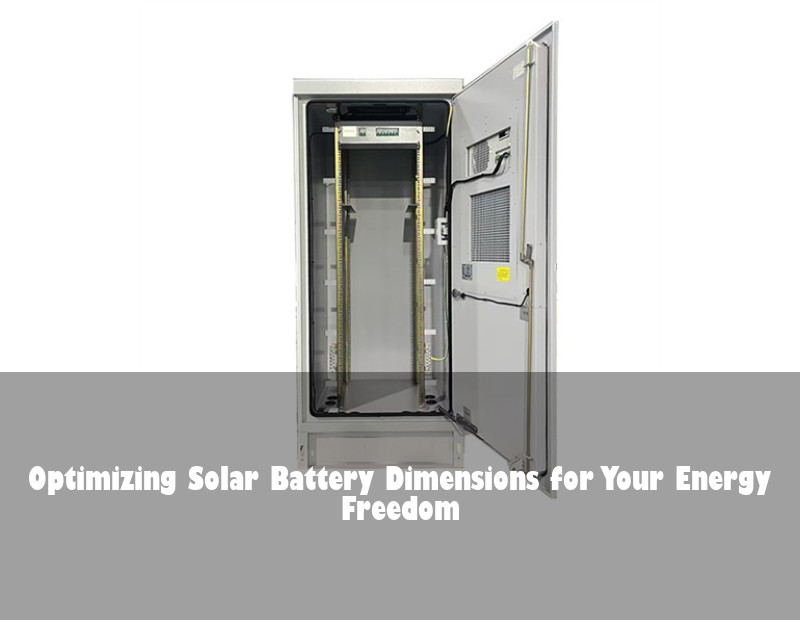
You're ready to harness the sun's power and store it for when you need it most. But as you plan your solar-plus-storage system, a crucial question arises: "Will this solar battery fit?" Understanding solar battery dimensions isn't just about measurements; it's about seamlessly integrating clean energy into your home or business. Let's explore why size matters and how to choose wisely.
Table of Contents
- Why Solar Battery Dimensions Matter More Than You Think
- Key Dimensions Explained: Beyond Length, Width, Height
- Space Constraints & European Installation Realities
- Case Study: Maximizing Small Spaces in Berlin
- The Future: Are Solar Batteries Getting Smaller?
- Finding Your Perfect Fit: Key Considerations
Why Solar Battery Dimensions Matter More Than You Think
The Problem: Imagine investing in a cutting-edge solar battery, only to discover it won't fit in your utility room, garage, or basement. This isn't just inconvenient; it can derail your entire energy independence project and inflate installation costs.
The Data: European homes, particularly in historic city centres or terraced housing (common in the UK, Netherlands, and Germany), often have limited utility space. A 2023 survey by SolarPower Europe found that over 65% of residential retrofit projects cited "available installation space" as a top-3 decision factor for battery selection, often outweighing raw capacity alone.
The Insight: Battery dimensions directly impact:
- Installation Location: Can it be wall-mounted (saving floor space) or does it require a floor stand?
- Access & Safety: Are mandatory clearance zones for ventilation and service access achievable?
- Aesthetics: Can it be discreetly integrated or does it become an obtrusive feature?
- Scalability: Is there room to add more batteries later if your energy needs grow?
Key Dimensions Explained: Beyond Length, Width, Height
While L x W x H are the basics, savvy buyers dig deeper:
- Wall-Mounting Requirements: Height and weight dictate stud spacing and mounting hardware strength. A tall, heavy battery needs robust anchoring.
- Clearance Zones: Don't overlook this! Most batteries require 10-30cm clearance on sides/top for airflow and safe operation. Ignoring this can void warranties and cause overheating. Check the manufacturer's manual!
- Orientation Flexibility: Can the unit be installed vertically or horizontally? This flexibility can be a game-changer in tight spaces.
- Connection Points: Where are the cables and conduits? Front access is often easier in cramped quarters than rear access requiring more space behind the unit.
- Weight Distribution: Is the weight evenly distributed? This affects mounting stability and floor-loading concerns, especially in older buildings.
Comparing just the core volume (LxWxH) gives an incomplete picture. Always factor in the total footprint including clearances.
Space Constraints & European Installation Realities
European homes present unique challenges. Think of narrow Victorian terraces in London, compact apartments in Barcelona, or cellar installations in Alpine homes. Basements might be damp, garages unheated, and utility closets tiny. This is where solar battery dimensions become critical.
Regulations Add Complexity: Local building codes, like Germany's VDE-AR-E 2510-50 for battery storage, often mandate specific installation clearances and locations, further limiting options in tight spaces.
The Trend: Manufacturers are acutely aware. We see a strong push towards:
- Slimmer Profiles: Reducing depth for tighter wall fits.
- Modular Designs: Stacking or clustering smaller units to fit irregular spaces and scale capacity without needing one large footprint.
- Enhanced IP Ratings: Allowing safe installation in garages or outdoors (where space might be less constrained).
Case Study: Maximizing Small Spaces in Berlin
The Challenge: A family in a Berlin Altbau apartment (circa 1900) wanted energy independence. Their only viable location was a narrow, unheated cellar corridor (available space: H 180cm x W 70cm x D 40cm). They needed at least 8kWh usable capacity.
The Solution: After evaluating multiple options based on strict solar battery dimensions and cold-temperature performance, a solution using two modular 5kWh batteries was chosen. Key specs:
- Single Unit Dimensions (incl. brackets): 60cm H x 45cm W x 18cm D
- Required Clearance: 5cm sides/top, 10cm front
- Operating Temp: -10°C to 50°C
- Orientation: Wall-mounted (vertical)
The Result: The two units were mounted side-by-side vertically within the tight corridor. The slim depth (18cm + 10cm front clearance) fit perfectly within the 40cm available depth. Total installation footprint was minimized, meeting safety codes and providing the required capacity. This project, documented by Fraunhofer ISE, highlights how precise dimensioning enables solar storage in historically challenging spaces.
The Future: Are Solar Batteries Getting Smaller?
Energy density (kWh stored per liter of volume) is the holy grail. Lithium-ion technology continues to improve. According to IRENA, average energy density for new residential batteries increased by ~15% between 2020 and 2023. This means more capacity in the same, or even smaller, footprints.
What's Next? Solid-state batteries (still in development) promise potentially significant leaps in energy density and safety, possibly leading to dramatically smaller solar battery dimensions within the next 5-10 years. However, for today's installations, focus on optimizing space with current efficient designs.
Finding Your Perfect Fit: Key Considerations
Ready to ensure your solar battery fits like a glove? Ask these questions:
- Precisely measure your intended location: Include ceiling height, width, depth, and factor in mandatory clearances. Don't forget door widths for access!
- Consider the environment: Is the space temperature-controlled? Damp? Subject to flooding? This impacts both suitable models and potential need for protective enclosures (adding to effective size).
- Think long-term: Might you add capacity later? Ensure your location allows for adding another unit or upgrading.
- Consult an expert installer early: They understand local codes (essential reference: Energy Storage News regional guides) and can perform a site survey to recommend models that truly fit your physical and energy needs.
What unique space challenge are you trying to solve with your solar battery installation? How have dimensions influenced your search?
 Inquiry
 Online Chat