


Harnessing Breezes: The Revolutionary Micro Wind Turbine by Nils Ferber
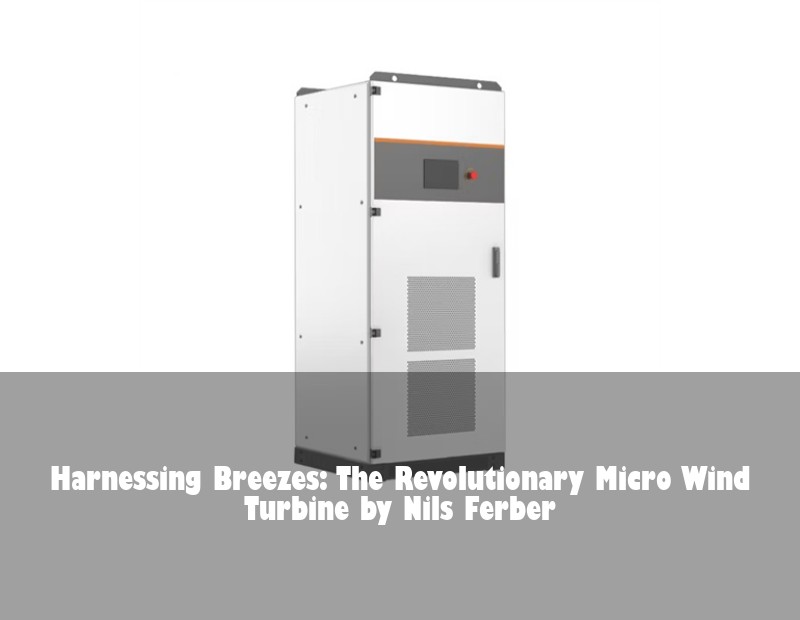
Imagine powering your off-grid cabin with nothing but gentle winds, or supplementing your rooftop solar panels during cloudy days. For European homeowners and eco-entrepreneurs, the micro wind turbine by Nils Ferber is turning this vision into reality. Unlike traditional wind giants, these compact vertical-axis turbines thrive in urban settings and low-wind conditions, offering a missing puzzle piece in distributed renewable energy. Let's explore how this German-engineered innovation is reshaping small-scale wind power.
Table of Contents
- The Urban Energy Challenge: When Solar Isn't Enough
- Wind's Untapped Potential: What the Numbers Reveal
- Nils Ferber's Micro Turbine: Engineering Meets Elegance
- Real-World Impact: A Swedish Island Case Study
- Beyond Kilowatts: Why This Changes the Game
- Where Micro Wind is Headed Next
The Urban Energy Challenge: When Solar Isn't Enough
Across European cities like Berlin or Lyon, homeowners face a frustrating paradox: rooftop solar panels sit idle during long winter nights and overcast days, while consistent breezes flow unused between buildings. Traditional horizontal turbines? Too noisy and bulky for dense neighborhoods. This gap leaves urbanites dependent on grids still powered by fossil fuels. "My solar panels produce nothing for 16 hours daily," notes Munich resident Elke Schmidt. "We need complementary solutions that work when the sun doesn't."
Wind's Untapped Potential: What the Numbers Reveal
Consider these eye-opening statistics:
- Europe has over 200 million urban dwellings with viable wind resources (≥3 m/s average winds)
- Micro-wind installations grew 17% annually since 2020, yet penetration remains below 3% of suitable sites
- Vertical-axis turbines like Ferber's operate at 30-40% efficiency in turbulent urban airflow where horizontal turbines fail
Data from the European Wind Energy Association confirms urban areas represent a 12GW untapped capacity – enough to power 8 million homes.
Nils Ferber's Micro Turbine: Engineering Meets Elegance
Enter Berlin-based engineer Nils Ferber's solution: a vertical-axis micro turbine (Ferber Engineering) that looks more like kinetic art than machinery. Its helical blades spin silently at wind speeds as low as 2 m/s (7.2 km/h), generating 500W-1kW depending on models. Key features include:
- Space-Smart Design: 1.2m height fits balconies or small gardens
- Grid-Agnostic Operation: Direct DC coupling with solar+battery systems
- Storm Resilience: Auto-braking at 13 m/s winds (no dismantling needed)
"We optimized every component for real-world chaos – gusty winds, bird strikes, even curious kids," Ferber explains. "It's not about max theoretical output, but reliable daily yield."
Real-World Impact: A Swedish Island Case Study
On Gotland Island, Sweden, the Olsson family transformed their energy independence using two Ferber turbines:
- Location: Coastal farmhouse (avg. wind: 4.5 m/s)
- System: 2x Ferber VA-800 turbines + existing 8kW solar array
- Results (12-month data):
- Wind contributed 1,842 kWh (38% of winter consumption)
- Reduced diesel generator usage by 70%
- ROI achieved in 4.2 years (vs. 6.5 years for solar-only expansion)
"November used to mean diesel fumes and noise," says Karin Olsson. "Now our turbines whisper through Baltic storms while charging our batteries." This aligns with IEA findings showing hybrid wind-solar systems increase off-grid reliability by up to 90%.
Beyond Kilowatts: Why This Changes the Game
Ferber's design overcomes micro-wind's historic hurdles. Unlike early prototypes prone to vibration damage, its carbon-fiber blades use aerospace dampening technology. Maintenance? Just annual bearing checks – a DIY job. But the real breakthrough is economic: at €2,300 installed, it competes with solar expansions where space is limited. "We're seeing farmers mount them on barn corners and cafes on terraces," notes renewable consultant Matthias Vogel. "It's democratizing wind power."
Where Micro Wind is Headed Next
With EU regulations now favoring integrated renewable systems (EU Energy Directorate), expect innovations like:
- Building-integrated versions replacing balcony railings
- AI-powered "wind harvest" forecasting synced with smart grids
- Modular designs scaling from 200W (cottages) to 5kW (small businesses)
Your Turn: What Could the Invisible Wind Do For You?
Could your business offset nighttime energy costs with rooftop micro-turbines? Might your community project benefit from silent, sculpture-like generators? Share your vision for hyper-local wind power – we're all ears!
 Inquiry
 Online Chat