


The Strategic Power Play: How Large Battery Storage Companies Are Reshaping Global Energy
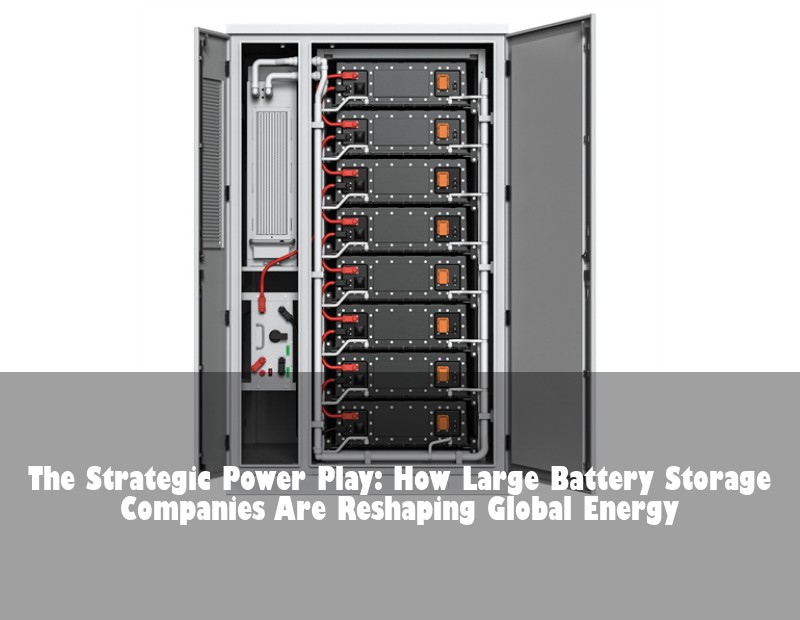
Imagine flipping a light switch during a windless night when solar panels lie dormant. This daily reality exposes the core challenge of renewable energy: its intermittency. Now enter large battery storage companies, the unsung heroes transforming this vulnerability into a strategic advantage. Their grid-scale solutions ensure that the clean energy generated today powers tomorrow's needs—especially crucial for renewables-heavy European markets like Germany and Spain. As Europe accelerates toward carbon neutrality, these industrial-scale storage pioneers are literally electrifying the energy transition.
Table of Contents
The Grid Balancing Act: When Renewables Meet Reality
Here’s a paradox: Europe generates record solar and wind power yet faces increased grid instability. Why? Because sunshine and wind are famously inconsistent guests. Picture Germany’s grid operators scrambling during the "Dunkelflaute"—those dreaded cold, windless winter weeks when renewable output plummets by over 70%. Without massive storage buffers, utilities must fire up coal plants, undermining decarbonization goals. This volatility isn't just inconvenient; it costs European economies billions annually in grid-balancing fees and curtailed renewable energy. Battery storage systems act as "shock absorbers," absorbing excess solar at noon and releasing it during peak demand.
Europe's Storage Surge: The Data Driving Adoption
Numbers reveal the explosive momentum. Europe deployed 4.5 GWh of grid-scale storage in 2023—a 94% year-on-year jump—with forecasts predicting 44 GWh by 2030. Driving this? Not just environmental policies but hard economics:
- Price Plunge: Lithium-ion battery costs fell 89% since 2010, making 100+ MWh projects financially viable
- Revenue Streams: Large-scale storage now monetizes through 6+ channels: frequency regulation, capacity markets, and wholesale arbitrage
- ROI Acceleration: Projects like Spain’s 200 MW plant now achieve payback in 3-5 years vs. 8+ a decade ago
Industry giants like Fluence and Wärtsilä dominate this landscape, leveraging AI-driven energy management platforms that turn raw storage into grid intelligence.
Benchmark Case: How UK's Grid Escaped the "Solar Cliff"
Let’s dissect a real-world victory. In 2022, Britain faced a crisis: its 14 GW solar fleet would crash output by 80% during evening peak demand—a phenomenon dubbed the "Solar Cliff." National Grid partnered with Tesla’s Megapack to deploy 98 MW/196 MWh across Kent and Sussex. The results?
- ⚡ 40% reduction in grid balancing costs within 6 months
- 🌍 112,000 tons of CO2 displaced annually
- ⏱️ 0.1-second response to frequency drops (vs. 30 sec for gas plants)
This project became Europe’s blueprint, proving storage isn’t auxiliary—it’s foundational. As the IEA notes, such systems prevent €1.2B/year in potential blackout losses across EU grids.
Beyond Megawatts: The Technology Leap
Leading storage companies aren’t just scaling up; they’re redefining hardware and software integration. Consider these breakthroughs:
Chemistry 2.0: Beyond Lithium-Ion
While lithium dominates, companies like Northvolt now deploy sodium-ion batteries for cold-weather reliability—crucial for Scandinavian markets. Their new Swedish facility boasts 20% higher cycle life at -30°C.
AI Orchestration: The Real Game-Changer
Modern storage isn’t passive; it’s predictive. Fluence’s Mosaic platform uses machine learning to forecast energy prices and grid needs 72 hours ahead, optimizing charge/discharge cycles. This turns storage assets into profit engines, autonomously trading across energy markets.
Beyond 2025: The Next Frontier
What’s next? Three seismic shifts loom:
- Second-Life EV Batteries: Renault’s "Advanced Battery Storage" project uses retired EV packs for 70 MW storage—slashing costs 40%
- Hydrogen Hybrids: Siemens Gamesa pilots "green hydrogen" storage, converting excess wind into H2 for weeks-long storage
- Virtual Power Plants (VPPs): Aggregating home batteries into grid-scale assets—Germany’s Next Kraftwerke already manages 10,000+ units
These innovations position storage not as cost centers but as grid architects.
What’s Your Energy Resilience Threshold?
As Europe’s grids strain under climate extremes and renewable targets, one truth emerges: large battery storage companies aren’t merely suppliers—they’re strategic partners in energy sovereignty. Whether you’re a utility facing winter shortfalls or an industrial user navigating volatile tariffs, the question isn’t if you need storage, but how much and how soon. Which energy challenge will you tackle first: price volatility, grid dependency, or carbon compliance?
 Inquiry
 Online Chat