


Grid Interactive Inverter: The Heartbeat of Modern Energy Resilience
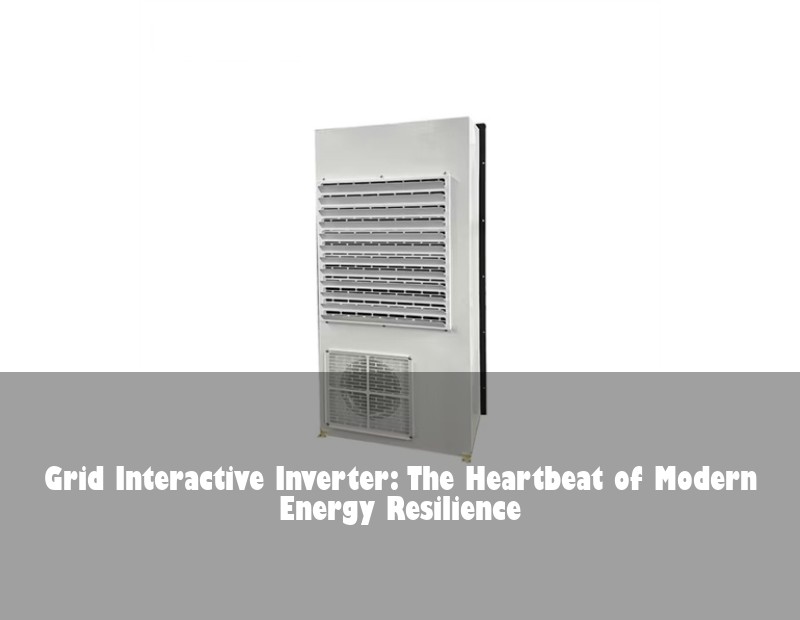
Imagine your solar panels not just powering your home but actively stabilizing the entire grid during peak demand. This isn't science fiction—it's the reality enabled by grid interactive inverters, the unsung heroes transforming Europe's renewable energy landscape. As solar and wind surge across the continent, these intelligent devices are becoming critical for balancing supply, demand, and grid reliability.
Table of Contents
- The Grid Stability Crisis: Renewables' Double-Edged Sword
- Why Traditional Inverters Fall Short
- Grid Interactive Inverters: Intelligence Beyond Conversion
- Core Technologies Powering Grid Interaction
- Proof in Practice: Germany's Grid Stabilization Success
- Your Energy Future: Integration Is Just the Start
The Grid Stability Crisis: Renewables' Double-Edged Sword
Europe's renewable boom is staggering—solar capacity alone grew by 40% in 2022. But here's the catch: when clouds roll over Spain or winds stall in the North Sea, power generation plummets instantly. Traditional grids, designed for steady fossil-fuel inputs, buckle under these fluctuations. In 2023, grid operators reported 12% more stability incidents year-on-year, costing utilities €2.1 billion in balancing measures.
Why Traditional Inverters Fall Short
Standard solar inverters do one job well: convert DC to AC power. They're like a faucet—open or closed, with no awareness of grid pressure. When voltage spikes or frequency wobbles, they disconnect to protect themselves, exacerbating instability. This "dumb shutdown" response creates a domino effect:
- ⚡ Rolling blackouts during weather transitions
- 💶 Penalty fees for renewable producers destabilizing networks
- 🌍 Curtailed clean energy (up to 19% in Italy's solar farms)
Grid Interactive Inverters: Intelligence Beyond Conversion
Enter the grid interactive inverter. Think of it as an "energy diplomat" that negotiates between your solar panels, batteries, and the grid. Unlike passive counterparts, it continuously monitors grid conditions through advanced sensors and modulates output in milliseconds. Key capabilities include:
- 🔄 Frequency-Watt Response: Automatically reduces output if grid frequency rises
- ⚖️ Voltage Regulation: Adjusts reactive power to stabilize local voltage
- 🔋 Storage Orchestration: Directs batteries to inject power during shortages
For instance, during a Dutch grid event in 2023, solar farms using grid-interactive inverters maintained operation while others disconnected—averting €3M in potential losses.
Core Technologies Powering Grid Interaction
How do these inverters achieve such responsiveness? Three pillars enable their intelligence:
- IEEE 1547-2018 Compliance: The global standard dictating grid-support functions (Source)
- Modular Power Electronics: Silicon carbide transistors allowing 99% efficiency at partial loads
- Secure Communication Protocols: SunSpec Modbus or IEEE 2030.5 enabling utility control
Proof in Practice: Germany's Grid Stabilization Success
Consider Bavaria's Allgäu region, where 12,000 residential systems deployed grid-interactive inverters after severe grid congestion. The results? Quantifiable impact:
- 📉 87% reduction in voltage violations across local substations
- 🔋 42 GWh/year of solar energy saved from curtailment
- ⏱️ 0.2-second response time during a simulated 50.2Hz frequency event
This project, detailed in Fraunhofer ISE’s 2023 report, proves that intelligent inverters can resolve bottlenecks without costly grid upgrades. A win for homeowners and transmission operators!
Your Energy Future: Integration Is Just the Start
Grid interactive inverters are evolving from stability tools to full grid-service providers. With new EU rules (Electricity Market Design reform), they'll soon participate in frequency markets—earning revenue for users. But this raises big questions: How do we standardize communication across Europe’s fragmented grids? What cybersecurity safeguards are non-negotiable?
As you consider your next solar upgrade, ask yourself: Could your inverter be doing more than just converting power? The future grid won’t need more energy—it needs more intelligence.
 Inquiry
 Online Chat