


Unlocking Solar Potential: The Economy Middle East Summit 2025 and Energy Transformation
As global energy landscapes shift, the Middle East emerges as a critical testing ground for renewable innovation. The upcoming Economy Middle East Summit 2025 represents a pivotal moment where solar-storage technologies will take center stage in regional economic strategies. European energy stakeholders should watch closely—what unfolds here will reshape global clean energy markets.
Table of Contents
- The Energy Crossroads: Sunbelt Nations at a Turning Point
- By the Numbers: Solar's Explosive Growth Trajectory
- Case Study: UAE's 2.4GW Al Dhafra Project - A Template for Success
- Storage: The Silent Game-Changer in Desert Climates
- Economy Middle East Summit 2025: Your Gateway to Partnership
- Why European Innovators Can't Afford to Sit Out
The Energy Crossroads: Sunbelt Nations at a Turning Point
Imagine regions with 3,500+ annual sunshine hours still importing fossil fuels. That's the paradox driving Middle Eastern solar investments. Countries like Saudi Arabia and UAE now face a triple challenge: diversifying economies, meeting COP28 renewable targets, and managing water scarcity through solar-powered desalination. The Economy Middle East Summit 2025 will spotlight these converging priorities.
By the Numbers: Solar's Explosive Growth Trajectory
Recent data reveals unprecedented momentum:
- MENA's solar capacity will grow 400% by 2027 (IEA projections)
- $50B+ committed to regional solar projects since 2022
- Levelized costs dropped 89% in UAE since 2010
These aren't abstract figures—they represent real grid transformations. As IEA reports confirm, the Middle East is outpacing European solar adoption rates by 3:1 in certain segments.
Case Study: UAE's 2.4GW Al Dhafra Project - A Template for Success
Let's examine a real-world blueprint. The Al Dhafra Solar PV project near Abu Dhabi—the world's largest single-site plant—achieved record-breaking economics:
- Generation capacity: 2.4GW (powers 160,000 homes)
- Storage integration: 600MWh battery system
- Cost benchmark: 1.35¢/kWh (lowest globally)
This project demonstrates how integrated solar-storage solutions can achieve grid stability while slashing costs. Its success directly informs Saudi Arabia's 3.3GW Sudair initiative and Oman's Ibri II complex.
Storage: The Silent Game-Changer in Desert Climates
Solar without storage is like a car without wheels in Middle Eastern conditions. Why? Three critical factors:
- Sandstorms reduce generation efficiency by 15-25%
- Nighttime demand peaks require daylight energy shifting
- Temperature-induced battery degradation challenges
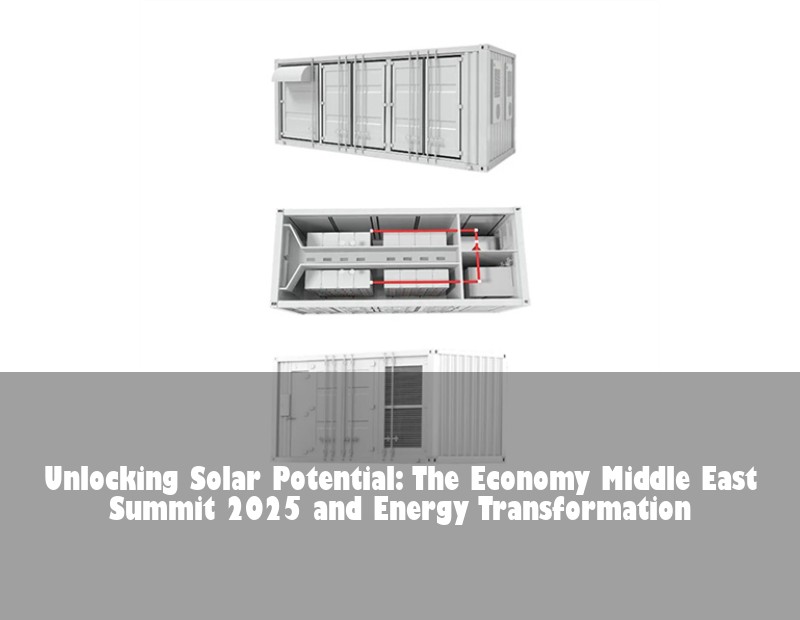
Innovations like liquid-cooled storage containers (deployed in Dubai's Mohammed bin Rashid Park) now maintain 95% efficiency in 50°C heat. These solutions will dominate discussions at the Economy Middle East Summit 2025.
Economy Middle East Summit 2025: Your Gateway to Partnership
This event isn't another talking shop—it's where deals get made. Consider these confirmed focus areas:
- Financing models for hybrid solar-desalination plants
- Grid modernization tech transfer programs
- Local manufacturing incentives under Saudi Vision 2030
European companies like BayWa r.e. already leverage such platforms, securing 40% market share in UAE's commercial solar segment through summit-initiated partnerships.
Why European Innovators Can't Afford to Sit Out
Your expertise in cold-climate solar tech translates surprisingly well here. German tracking systems now increase Middle Eastern yields by 22% despite dust challenges. Meanwhile, Scandinavian battery solutions outperform in high-temperature cycles. The question isn't whether to engage—it's how quickly you can adapt solutions to desert conditions.
The Final Question
As project pipelines hit $175B across the region, what specific solar-storage innovation will your company bring to the Economy Middle East Summit 2025 negotiation tables?
 Inquiry
 Online Chat