


Complete Off Grid Power Systems: Your Path to Energy Independence
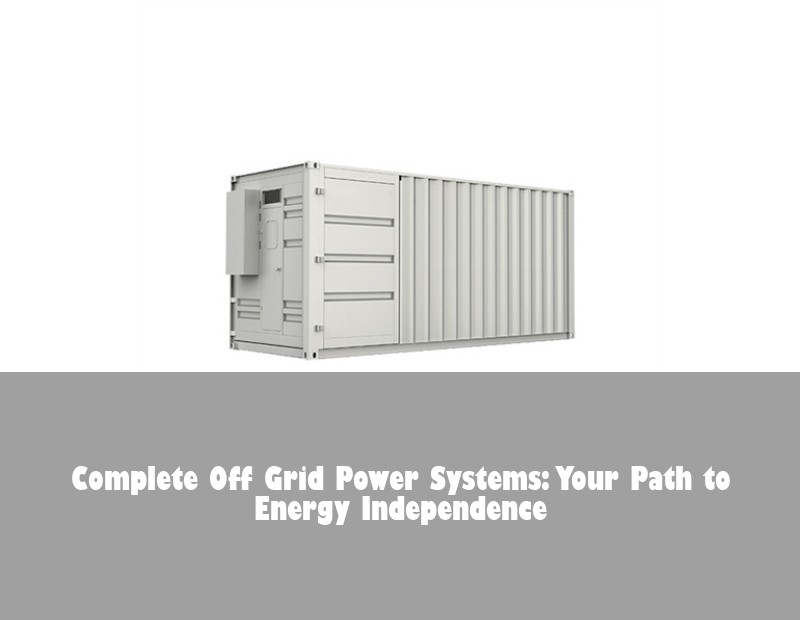
Imagine waking up to a frosty Scandinavian morning with no grid connection, yet your home hums with warmth and light. Across Europe, a quiet energy revolution is unfolding as homeowners and businesses embrace complete off grid power systems. These integrated solutions—combining solar generation, intelligent storage, and smart management—are redefining self-sufficiency from the fjords of Norway to the vineyards of Tuscany. No longer just a backup plan, they represent a fundamental shift toward resilience in an era of volatile energy prices and climate uncertainty. Let's explore how these systems work, why they matter, and how they're transforming lives today.
Table of Contents
- Why Off-Grid Systems Are Surging in Europe
- Anatomy of a Complete Off-Grid System
- Tangible Benefits Beyond Energy Independence
- Real-World Success: A Swedish Island Case Study
- Future-Proofing Your Energy Infrastructure
- Your Energy Independence Journey Starts Here
Why Off-Grid Systems Are Surging in Europe
Europe's energy landscape is at a crossroads. Grid instability incidents have increased by 30% since 2020 according to the European Environment Agency, while electricity prices in Germany and Spain saw 150% spikes during 2022's energy crisis. For remote communities, farms, and eco-conscious homeowners, this volatility isn't just inconvenient—it threatens livelihoods. Complete off-grid systems solve this by creating self-contained energy ecosystems. Unlike grid-tied hybrids, these systems operate independently 24/7, using solar as the primary engine and batteries as the beating heart. The psychological shift is profound: users report feeling "energy ownership" rather than "energy dependency."
Anatomy of a Complete Off-Grid System
Think of these systems as a symphony orchestra—each component plays a critical role:
Solar Array: The Power Generator
High-efficiency monocrystalline panels (22-24% yield) capture sunlight even at Nordic latitudes. For a typical European home, 8-12 kW systems are common.
Battery Bank: The Energy Reservoir
Lithium iron phosphate (LiFePO4) batteries dominate modern installations, offering 6,000+ cycles at 90% depth of discharge. A 20 kWh bank can power a 3-bedroom home for 48+ hours.
Intelligent Inverter/Charger: The Brain
Multifunction devices like Victron MultiPlus-II handle AC/DC conversion, battery charging, and generator auto-start during prolonged clouds.
Backup Generator: The Safety Net
Biofuel-compatible generators provide emergency power during winter's shortest days, seamlessly activated by the system controller.
Tangible Benefits Beyond Energy Independence
While energy security is the headline, the ripple effects surprise many adopters:
- Financial Certainty: Lock in energy costs for 20+ years, avoiding market fluctuations
- Zero Grid Fees: Save €500-€2,000 annually in transmission charges
- Carbon Neutrality: A 10 kW system prevents 8-10 tons of CO2 annually
- Property Value: UK studies show 14% premium for energy-autonomous homes
As the International Energy Agency notes, off-grid systems now achieve levelized costs below €0.18/kWh—outperforming grid power in many regions.
Real-World Success: A Swedish Island Case Study
Consider the Olsson family on Gotland Island, Sweden. Facing frequent winter outages and €0.32/kWh electricity, they installed a turnkey system in 2022:
- System: 14.4 kW solar + 25.6 kWh LiFePO4 storage + 8 kVA inverter
- Performance: Generated 11,200 kWh annually (110% of needs)
- Results: €0 operational costs, 98% self-sufficiency, payback in 7 years
"We've not just saved money," says Henrik Olsson. "We've gained peace of mind during blizzards that used to paralyze our community." This mirrors findings from Fraunhofer ISE, showing Scandinavian off-grid installations growing at 22% CAGR.
Future-Proofing Your Energy Infrastructure
Modern systems are designed for evolution. With modular architecture, you can:
- Integrate wind turbines for winter diversity
- Add hydrogen storage for seasonal balancing
- Upgrade software for AI-driven consumption forecasting
The key is oversizing your initial solar array by 20-30% and choosing inverters with expansion ports. As battery densities improve (projected 40% by 2030), your system's capacity grows without replacing core components.
Your Energy Independence Journey Starts Here
Designing your perfect system begins with three questions: What are your non-negotiable loads (medical equipment? water pumps?), what's your worst-case weather scenario, and how do you envision your energy future? Solar professionals across Europe now offer virtual energy audits—why not discover what autonomy could look like for your home? What's the first appliance you'd power with your personal energy ecosystem?
 Inquiry
 Online Chat